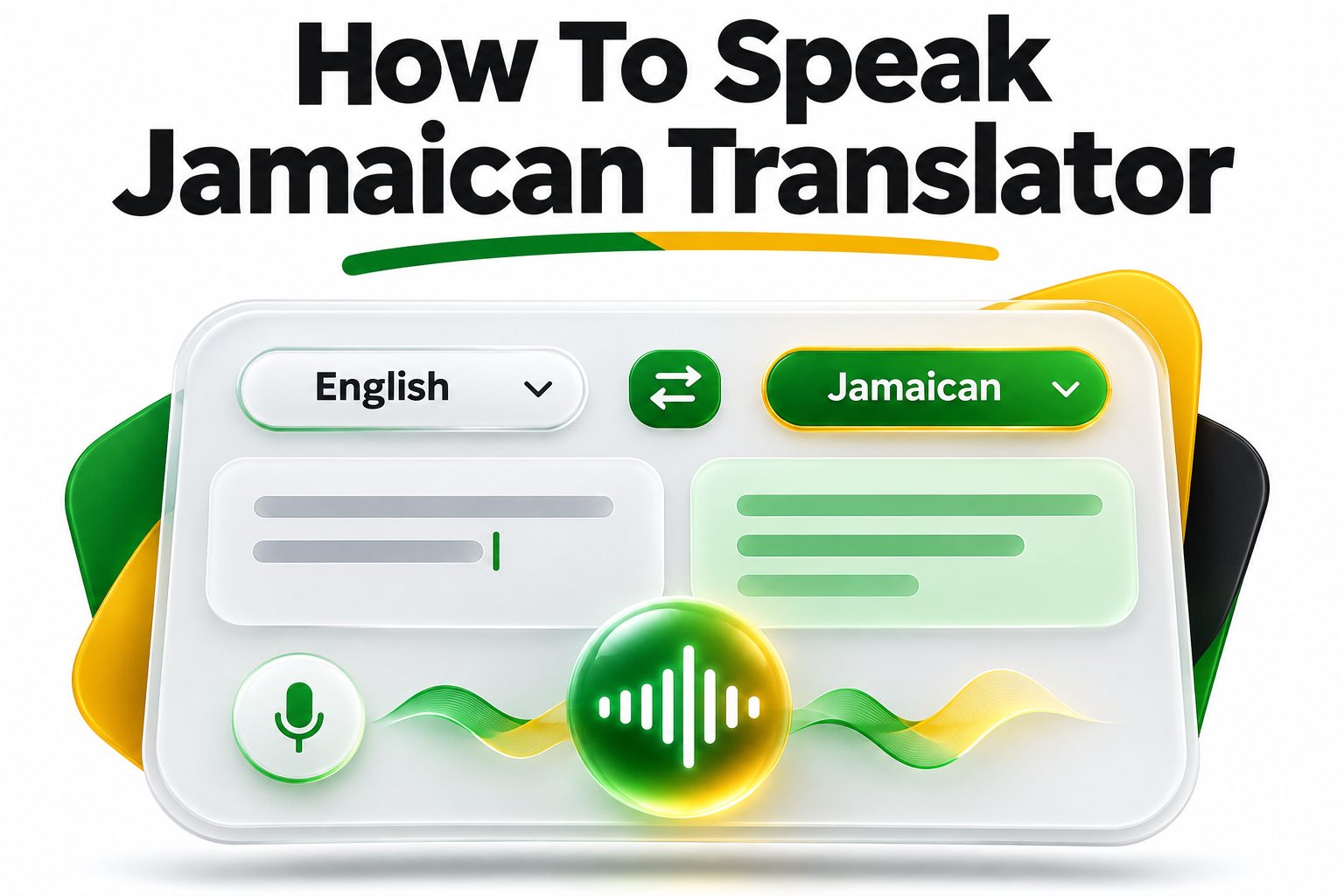
Jamaican speech has a rhythm, vocabulary, and personality that many people want to learn, but it is not simply English with a different accent. When people search for a how to speak jamaican translator, they are usually looking for a quick way to turn standard English into Jamaican Patois, also called Jamaican Creole or Patwa. A translator can be useful for casual phrases, captions, messages, and travel basics, but it cannot always capture tone, regional wording, or the social context behind a phrase.
The best approach is to use a translator as a starting point, then learn the common sentence patterns and listen to real speakers. That helps you avoid stiff, literal translations and makes your wording sound more respectful. This article explains how Jamaican Patois works, how to use online translation tools carefully, which phrases are safe for beginners, and how to build confidence without pretending to speak a dialect you do not yet know well.
Jamaican Patois and Standard English
Jamaican Patois is an English-based Creole language spoken widely in Jamaica and across Jamaican communities worldwide. It developed through contact between English, West African languages, and other linguistic influences during Jamaica’s colonial history. It has its own grammar, pronunciation, vocabulary, and expressive style.
Standard English is also used in Jamaica, particularly in formal education, business, government, and written communication. Many Jamaicans move naturally between Standard English and Patois depending on the setting. Treating Patois as “broken English” misses the fact that it follows consistent language patterns and carries a rich cultural identity.
What a Jamaican Translator Can Do
A Jamaican translator can help convert simple phrases such as “How are you?” into “Wah gwaan?” or “Mi deh yah” for “I am here.” These tools are useful when you need a basic starting point for an informal conversation, social post, lyric explanation, or travel situation.
Translation tools work best with short, direct sentences. They often struggle with humor, slang, idioms, emotional tone, and words that have different meanings depending on who says them. A phrase that sounds friendly among close friends may sound overly familiar, performative, or confusing in another setting.
Useful ways to use a translator include:
- Translating short everyday phrases before a trip
- Checking the meaning of a Patois expression you heard in music or conversation
- Comparing multiple translations for a casual message
- Learning common greetings and responses
- Building flashcards with phrases you can verify through real examples
Start With the Meaning, Not the Accent
The most natural way to speak Jamaican Patois is to focus on meaning and structure before trying to copy pronunciation. Accent imitation without familiarity with the language can sound forced, especially when a speaker uses exaggerated sounds or borrowed slang without knowing its context.
Begin with phrases you would genuinely use. Learn what they mean, when they fit, and how people respond. A simple, accurately used “Respect” is far better than a long sentence copied from a translator that you cannot explain or pronounce comfortably.
Common Sentence Patterns in Jamaican Patois
Jamaican Patois often uses a structure that differs from Standard English. Pronouns, tense markers, and forms of “to be” may work differently. You do not need to master grammar immediately, but recognizing these patterns makes automated translations easier to judge.
For example, “Mi” can mean “I” or “me,” while “yuh” can mean “you” or “your.” “A” may indicate an ongoing action, as in “Mi a go” for “I am going.” Context helps listeners determine the intended meaning.
Here are a few beginner-friendly patterns:
| Standard English | Jamaican Patois | Notes |
|—|—|—|
| I am fine | Mi deh yah | Literally suggests being present or okay |
| What is happening | Wah gwaan | A common informal greeting |
| I do not know | Mi nuh know | “Nuh” is a negative marker |
| You are going home | Yuh a go home | “A” marks an ongoing or near action |
| They are coming | Dem a come | “Dem” can mean they or them |
| It is good | It nice | “Nice” often means good or pleasant |
Translation Tools Need Human Checking
A how to speak jamaican translator can produce quick results, but it should not be your only source. Many online tools are based on limited phrase databases, user submissions, or literal word substitutions. That can produce translations that are technically recognizable but unnatural in actual conversation.
When possible, compare the result with examples from Jamaican speakers, reputable language resources, interviews, or subtitled videos. Pay attention to whether the phrase is current, casual, respectful, or tied to a specific age group or community. Language changes quickly, especially slang.
Signs a Translation May Be Unreliable
Some translations should make you pause before using them. A tool may translate each English word separately even when the English sentence has an idiom that needs a completely different expression. It may also assign one Patois phrase to several English meanings without explaining the difference.
Be careful when a translation includes insults, sexual language, heavily localized slang, or terms you have never heard spoken by a Jamaican person. These phrases can carry stronger meanings than an English gloss suggests. When in doubt, keep your wording simple and ask a native speaker for clarification.
Use a Translator in a Practical Order
Using a translation tool thoughtfully takes only a few extra minutes. The goal is not to make every message sound like a native speaker wrote it. The goal is to communicate clearly, learn steadily, and avoid accidental misuse.
1. Write the original thought in plain, short English.
2. Translate one sentence at a time instead of a full paragraph.
3. Check whether the result uses familiar words or grammar patterns.
4. Search for spoken examples of the phrase in a natural context.
5. Keep the final message simple if you are not sure of the tone.
6. Use Standard English when clarity matters more than style.
Everyday Jamaican Patois Phrases
A small set of everyday phrases can help you greet people and respond politely. These expressions are generally easier to use than deep slang because they appear often in casual conversation. Pronunciation and rhythm still vary among speakers, so listen before assuming there is only one correct sound.
“Wah gwaan” is often used like “What’s up?” or “How are things?” A common reply is “Mi deh yah,” which can mean “I’m here,” “I’m okay,” or “I’m managing.” “Respect” can be used to show appreciation, recognition, or thanks.
Greetings and Friendly Responses
“Big up” is a phrase of praise or acknowledgement. You might say “Big up yuhself” to encourage someone or give them credit. “Bless up” is another warm expression associated with goodwill, gratitude, or a positive farewell.
“Likkle more” often means “see you later,” while “Walk good” is a caring way to say goodbye, similar to wishing someone a safe journey. These phrases are more useful when spoken naturally and sparingly than when added to every message.
Common phrases worth learning:
- Wah gwaan — What is going on, how are things
- Mi deh yah — I am here, I am okay
- Respect — Thanks, appreciation, acknowledgement
- Bless up — Good wishes, appreciation, farewell
- Big up — Praise or recognition
- Likkle more — See you later
- Walk good — Take care, travel safely
- Mi soon come — I will be back soon
- Nuh worry yuhself — Do not worry
- Yuh good — You are okay, all good
Tone Changes the Meaning
Tone matters greatly in Jamaican Patois. A phrase can sound playful, serious, warm, impatient, or sarcastic depending on volume, pacing, facial expression, and the relationship between speakers. Text translators cannot reliably show those layers.
For example, “Yuh good” may be reassurance, a check-in, or a casual approval. In the right context it can mean “you’re fine,” while in another it may be an invitation to explain whether something is wrong. Listen closely before relying on a single dictionary definition.
Respectful Use of Patois
Learning Patois can be a meaningful way to connect with Jamaican culture, but respect should guide the process. Avoid using it as a costume, comedy accent, or shortcut to sound “cool.” People are usually more receptive when they can see that you are making a sincere effort to learn.
It is also fine to use Standard English. Jamaican people speak English, and clear communication matters more than proving that you know slang. Use Patois phrases when they fit the relationship and setting, not because you feel pressured to perform a particular identity.
Avoid These Common Mistakes
The most common error is assuming every English sentence needs a Patois equivalent. A translator may offer something, but that does not make it appropriate. Direct translation can erase meaning, especially with formal statements, workplace messages, apologies, and emotionally sensitive conversations.
Another mistake is mixing random slang into otherwise formal language. This can make a message difficult to read and may sound unnatural. Learn a few phrases thoroughly, then expand your vocabulary through real listening and conversation.
Do:
- Ask what a phrase means before repeating it
- Use simple expressions you can pronounce and explain
- Learn from Jamaican creators, teachers, and speakers
- Notice when people switch between Patois and Standard English
- Accept corrections graciously
Do not:
- Copy an exaggerated accent to imitate a speaker
- Use unfamiliar slang in professional or serious settings
- Assume one translation fits every island or Caribbean community
- Repeat offensive terms because a translator labels them casual
- Treat Patois as less valid than Standard English
Pronunciation and Listening Practice
Written Patois can look unfamiliar because spelling often reflects sound rather than Standard English conventions. The same word may also appear in more than one spelling. Focus first on recognizing the phrase when spoken, then choose a spelling style that your source uses consistently.
Listening is the fastest way to learn the flow of the language. Interviews, radio segments, podcasts, Jamaican films, and conversations can teach pacing that a text-only translator cannot. Start with slower content or videos with captions, then replay short clips until the rhythm becomes familiar.
Building a Simple Practice Routine
A short regular routine works better than cramming a long list of phrases. Choose five to ten words or expressions for the week. Write their English meanings, listen to examples, and make one realistic sentence for each. Repetition helps you remember both the vocabulary and the context.
You can also keep a phrase notebook with columns for the Patois expression, a direct gloss, the natural English meaning, and a sample situation. For more language-learning habits that make this approach easier, see [Internal Link: language learning tips for daily practice].
A practical weekly routine might look like this:
1. Learn two greetings and two responses on the first day.
2. Listen to ten minutes of natural Jamaican speech on the second day.
3. Repeat short phrases aloud and record yourself on the third day.
4. Review words in context rather than memorizing isolated translations.
5. Ask a knowledgeable speaker to correct one or two sentences.
Online Translators, Dictionaries, and Human Help
Online translators are convenient, especially for a fast phrase check. Their strength is speed. Their weakness is nuance. Use them for basic wording, but do not assume they have the same reliability as a professional translator or a language teacher familiar with Jamaican usage.
Dictionaries and glossaries can be better for individual words because they may give definitions, variations, and example sentences. Human help remains the best option for messages where tone matters, such as a speech, public post, personal note, or business communication.
Choosing the Right Option for Your Goal
Your best resource depends on what you need to do. For travel, a short phrase list and basic listening practice may be enough. For writing dialogue, you need stronger cultural knowledge and should work with a Jamaican reader or editor. For language study, use resources that explain grammar as well as vocabulary.
| Your goal | Best starting point | Main limitation |
|—|—|—|
| Learn a greeting | Phrase guide or translator | May not teach pronunciation |
| Send a casual text | Translator plus real examples | Tone can be misread |
| Understand a song lyric | Glossary and cultural context | Lyrics may use metaphor or slang |
| Write dialogue | Jamaican consultant or editor | Requires more time and budget |
| Prepare for travel | Audio phrase practice | Cannot cover every situation |
| Study Patois seriously | Lessons and regular conversation | Progress takes consistent practice |
When Standard English Is the Better Choice
There are times when Standard English is the clearest and most respectful option. Use it for medical needs, legal matters, workplace instructions, customer service complaints, important apologies, and situations where misunderstanding could create a problem.
You can still show warmth without using unfamiliar Patois. A friendly, direct message in Standard English is preferable to a poorly translated one. Communication is successful when the other person understands your intention, not when you use the most local-sounding vocabulary.
Writing Jamaican Patois for Captions and Messages
When writing a caption or friendly note, keep the message short. Patois is expressive, so a brief line often has more impact than a long, translated paragraph. “Bless up,” “Big up yuhself,” or “Walk good” can work well when they fit your existing relationship with the reader.
Avoid copying phrases from memes without checking their meaning. Social media often removes context, and spellings can be stylized for humor or personality. If you are writing for an audience, ask someone familiar with Jamaican Patois to review it before publishing. You may also find [Internal Link: writing culturally respectful social media captions] useful when adapting language for public posts.
Examples of Natural Beginner Use
A visitor meeting a Jamaican host might say, “Wah gwaan?” and then continue in English. That is often more natural than attempting a full conversation beyond their ability. The host may answer in Patois, English, or a mix of both.
A friend could write, “Big up yuhself pon the new job.” This is a warm congratulatory message meaning something close to “Big yourself up on the new job” or “Congratulations on your new job.” The phrase works because the context is positive and informal.
Troubleshooting Confusing Translations
If a result does not make sense, simplify the original English sentence. Idioms such as “I’m feeling under the weather” or “That was a close call” often need explanation before they can be translated meaningfully. Replace figurative English with a direct statement first.
It also helps to translate in both directions. Enter the Patois result back into English and see whether the core idea survives. This is not perfect, but it can reveal major errors. If the message is important, ask a Jamaican speaker rather than trusting a machine-generated result.
Conclusion
A translator can be a useful first step, especially for greetings, simple messages, and basic travel phrases. The strongest results come from pairing it with real listening, clear context, and a willingness to keep your language simple. Jamaican Patois has its own grammar, history, and cultural meaning, so literal word swaps rarely capture the full message.
Use short translations, check unfamiliar expressions, and pay close attention to tone. Learn phrases you can use naturally, such as “Wah gwaan,” “Mi deh yah,” and “Walk good,” instead of trying to copy an entire accent. For serious writing or sensitive conversations, seek help from a fluent Jamaican speaker. A how to speak jamaican translator is most helpful when it supports genuine learning rather than replacing it. With patience and respect, you can communicate more confidently while appreciating the language on its own terms.
Frequently Asked Questions
Is Jamaican Patois the same as Jamaican English?
No. Jamaican Patois is an English-based Creole language with distinct grammar and vocabulary. Jamaican English refers more broadly to English as spoken in Jamaica, including local pronunciation, expressions, and speech patterns.
Can Google Translate translate Jamaican Patois?
Sometimes, but results may be limited or unnatural. It can help with simple words and phrases, yet it may miss tone, current slang, and grammar. Check short translations against real examples whenever possible.
What does wah gwaan mean?
“Wah gwaan” means something like “What is going on?” or “How are things?” It is a casual greeting. A common response is “Mi deh yah,” meaning that you are here, okay, or managing.
Is it respectful for visitors to use Patois?
Yes, when used sincerely and appropriately. Learn a few phrases, pronounce them without exaggeration, and accept correction. Avoid treating Patois as a joke, costume, or collection of slang for entertainment.
What is the best way to learn Jamaican Patois?
Listen to Jamaican speakers regularly and practice common phrases in context. Use a translator for support, not as your only source. Lessons, trusted glossaries, videos, and conversations provide better context than word-for-word translations alone.


Leave a Comment