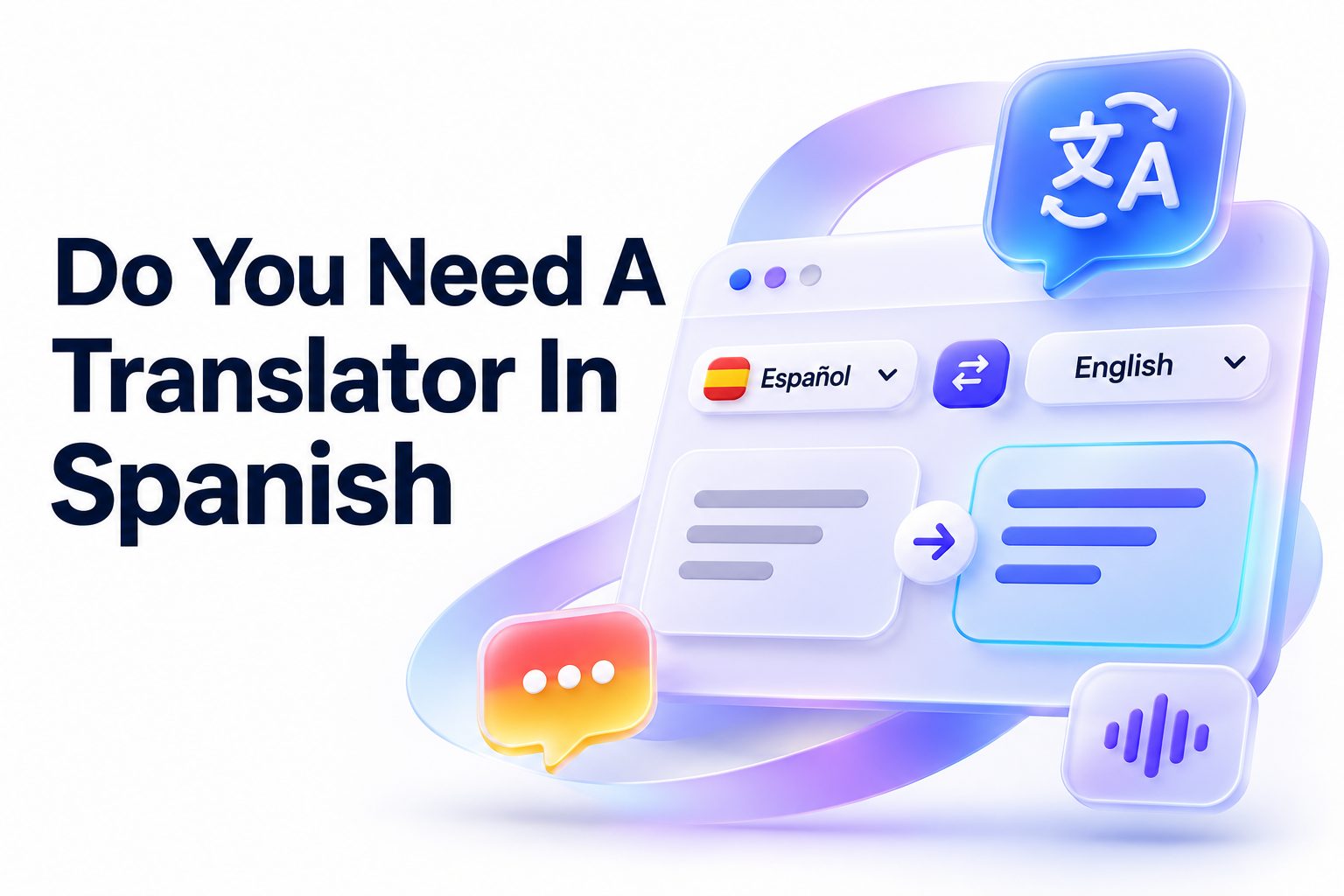
If you are asking, “do you need a translator in spanish,” the short answer is usually no for basic conversations—but the right choice depends on the situation. A translation app, bilingual friend, or a few prepared phrases may be enough when ordering food, asking for directions, or checking into a hotel. In medical, legal, immigration, business, or emergency situations, a qualified human interpreter can be essential.
Spanish is spoken across many countries and regions, with differences in accent, vocabulary, formality, and local customs. That does not mean communication has to feel intimidating. With a clear goal, a reliable translation method, and a little preparation, most travelers and newcomers can handle everyday interactions confidently. This article explains when a translator is useful, when technology is enough, how to choose the right support, and what to do when communication becomes more important than a simple phrase.
The Short Answer for Most Situations
You probably do not need a professional translator for routine travel in a Spanish-speaking country. Hotel staff, restaurants, attractions, transportation providers, and tourist-facing businesses often have some English support, especially in major cities. A translation app and basic Spanish phrases can cover many common needs.
The answer changes when accuracy carries consequences. Misunderstanding medical instructions, signing a contract, speaking with immigration authorities, or discussing a legal issue can create real problems. In these settings, relying on guesswork or an automated translation may not be enough.
Translator, Interpreter, and Translation App Differences
People often use “translator” to describe any language help, but the terms are not interchangeable. A translator usually works with written material, such as documents, websites, certificates, and contracts. An interpreter helps people communicate aloud in real time, in person, by phone, or through video.
Translation apps are useful tools, but they do not replace professional language services in every context. They can struggle with accents, poor internet connections, idioms, background noise, technical terms, and incomplete sentences. Treat them as practical support, not a guarantee of accuracy.
- Use a translation app for menus, signs, short messages, and basic requests.
- Use an interpreter for live appointments, negotiations, interviews, and official conversations.
- Use a document translator for written records, applications, certificates, or agreements.
- Ask for certified translation when an institution specifically requires it.
Everyday Travel Situations Where You Can Manage Without One
For a typical holiday, you can often communicate successfully with a phrasebook, downloaded translations, maps, and polite gestures. Many everyday interactions follow predictable patterns: buying tickets, asking where the restroom is, ordering meals, confirming a price, or requesting help at a hotel.
Preparation makes a noticeable difference. Learn a few useful words, save your accommodation address offline, keep copies of travel documents, and download Spanish for offline use in a translation app. Even limited Spanish becomes more effective when you speak slowly and keep your request simple.
Useful Spanish Phrases for Daily Needs
A handful of phrases can reduce your reliance on a translator. “Por favor” means please, “gracias” means thank you, and “perdón” can mean excuse me or sorry. “No hablo mucho español” tells someone that you do not speak much Spanish.
For practical questions, try “¿Dónde está…?” for “Where is…?” and “¿Cuánto cuesta?” for “How much does it cost?” If you need language help, “¿Habla inglés?” is the direct way to ask whether someone speaks English.
Making Translation Apps Work Better
Use short, direct sentences rather than long explanations. Instead of typing, “Could you please tell me if there is another bus that will take me near my hotel because I think I missed mine,” break it into two clear statements.
Show the translated text to the other person and allow them time to respond. If speech translation is not working, switch to typed text. Saving common phrases and place names before leaving Wi-Fi also prevents avoidable stress while traveling.
Situations Where a Professional Interpreter Is Worth It
An interpreter is worth considering when you need both sides to fully understand each other. That includes legal meetings, medical consultations, school conferences, job interviews, immigration appointments, insurance claims, and complex customer service disputes. The cost of misunderstanding may be greater than the cost of language support.
A professional interpreter does more than convert individual words. They help preserve meaning, clarify context, and keep communication organized. In sensitive settings, they should remain neutral, respect privacy, and accurately relay what each person says without adding opinions.
| Situation | Best language support | Why it matters |
|—|—|—|
| Restaurant or shopping | Translation app or basic phrases | The exchange is usually simple and low-risk |
| Hotel check-in | App, staff assistance, or bilingual booking details | Names, dates, and booking numbers are easy to verify |
| Doctor appointment | Professional medical interpreter | Symptoms, medication, and consent must be clear |
| Legal or immigration meeting | Qualified interpreter | Errors can affect rights, applications, or obligations |
| Employment contract | Professional translator and interpreter if needed | Terms, pay, duties, and conditions require precision |
| Emergency call | Emergency operator or local assistance | Speed and accurate location details are critical |
Medical Care Requires Clear Communication
Do not rely only on an app if you have a serious symptom, need emergency treatment, have allergies, or must make an important medical decision. Medical vocabulary is specific, and a mistranslated word can change the meaning of a diagnosis, instruction, or medication warning.
Ask the clinic, hospital, insurance provider, or embassy-related assistance service whether an interpreter is available. Bring a written list of medications, allergies, diagnoses, and emergency contacts in both English and Spanish where possible. This is also a useful reason to review [travel health insurance tips].
Preparing for a Medical Appointment
Write down your symptoms, when they started, what makes them better or worse, and any medication you have already taken. Use plain language. For example, “sharp pain on the lower right side for two days” is easier to interpret accurately than a vague description.
Ask the provider to explain instructions in small parts. Repeat back key details such as dosage, appointment dates, test preparation, and warning signs. This simple confirmation step can catch misunderstandings before you leave.
Legal, Immigration, and Official Documents Need Extra Care
Official documents often require more than a basic translation. Birth certificates, marriage certificates, academic records, court documents, immigration paperwork, and business filings may need a certified translation, depending on the country and receiving institution.
Never assume that a friend, online tool, or bilingual employee can meet an official requirement. Ask the organization receiving the document what it accepts. Requirements may include a signed certification, translator credentials, notarization, or an approved provider.
Questions to Ask Before Hiring Help
Before booking a language professional, explain the purpose of the document or meeting. Ask whether they have experience with the relevant field, such as medicine, law, immigration, education, or finance. Specialist knowledge matters when terms have precise meanings.
Confirm the language direction as well. Someone may be fluent in Spanish and English but not qualified to translate legal Spanish into formal English. Discuss pricing, turnaround time, confidentiality, and whether the final document includes any required certification.
Spanish Varies by Country and Region
Spanish is widely shared, but local vocabulary can differ. A word used for a car, bus, computer, straw, or restroom in one country may sound unfamiliar or mean something else elsewhere. Accent and speaking speed also vary from region to region.
These differences rarely prevent basic communication. Context, politeness, and willingness to clarify usually solve the problem. Still, localized wording can be especially valuable for business content, legal documents, healthcare information, and customer-facing materials.
- Say “baño” if you need a restroom, but be prepared to hear local alternatives.
- Use neutral terms when possible, especially in written materials aimed at several countries.
- Avoid slang unless you are certain of the local meaning.
- Ask someone to repeat or rephrase instead of pretending you understood.
- Keep addresses, names, reservation numbers, and important instructions written down.
Choosing Between an App, Bilingual Person, and Professional
The best option depends on risk, privacy, complexity, and frequency. For quick, low-stakes communication, technology is convenient and inexpensive. For something personal or important, a trained interpreter provides a safer and more respectful option.
A bilingual friend can be helpful for informal support, but they may not know specialized vocabulary or feel comfortable interpreting sensitive details. They can also unintentionally summarize instead of interpreting every statement. That may be acceptable for a casual errand but not for official matters.
When a Bilingual Friend Is Enough
A trusted bilingual person can help you buy a phone plan, arrange a simple appointment, meet a landlord for an initial conversation, or navigate local services. Make sure they are comfortable helping and that the situation does not expose private information they should not have to handle.
Keep the request proportionate. Asking a friend to translate a long contract or attend a court appointment places a heavy responsibility on them. In those cases, professional support is more appropriate and usually more reliable.
When Privacy Changes the Decision
Medical records, financial details, workplace disputes, family issues, and legal matters deserve extra discretion. A professional interpreter is typically bound by ethical and confidentiality expectations, while friends and informal helpers may not have the same training or safeguards.
If you use a translation app for sensitive information, consider the privacy policy and avoid uploading unnecessary personal documents. Apps can be useful for general wording, but they should not become your only safeguard for confidential communication.
Practical Steps Before a Spanish-Speaking Trip or
Planning ahead reduces the chance that you will need urgent help later. Start with the type of communication you expect: casual travel, temporary work, a move abroad, a medical appointment, or official paperwork. Your preparation should match that level of need.
For travel, focus on access and convenience. For professional or official situations, focus on accuracy and documentation. A little advance organization is often more useful than trying to solve a language barrier in the middle of a stressful moment.
1. Download an offline Spanish language pack in a reliable translation app.
2. Save your hotel, destination, and emergency contacts in both languages.
3. Learn a small set of phrases related to food, transport, money, and help.
4. Check whether scheduled appointments offer an interpreter.
5. Ask official organizations about translation or certification requirements in writing.
6. Carry printed copies of key reservations, medications, and addresses.
7. Keep a backup plan, such as a bilingual contact or interpreter service number.
Common Communication Mistakes to Avoid
Speaking louder does not make another language easier to understand. It is more effective to slow down, use short sentences, remove idioms, and communicate one idea at a time. A calm tone also encourages the other person to help rather than feel pressured.
Another common mistake is treating a machine translation as final proof of meaning. Translation tools can produce confident-looking results even when the context is wrong. Verify important details by asking for written confirmation, repeating back information, or using a qualified professional.
Avoiding False Confidence With Apps
A translation may be grammatically correct but inappropriate for the situation. Formal requests, gendered language, regional word choices, and technical terms are easy to mishandle. Read the translation back through the app when possible, or ask a fluent speaker to confirm it.
Be especially careful with negatives, numbers, dates, addresses, medication dosages, and legal obligations. These are small details with large consequences. Write them down and compare them carefully instead of relying on memory.
Helpful Alternatives to Hiring a Full-Time Translator
You do not need to hire someone for an entire day if you only need support for a short appointment or specific document. Many interpreters work by the hour, remotely by phone or video, or on an on-demand basis through language service providers.
You can also ask hotels, universities, employers, hospitals, and community organizations about bilingual staff or referral services. For relocation, a local guide or settlement service may help with practical tasks while a certified translator handles official paperwork. See [moving abroad checklist] for related preparation ideas.
| Need | Practical alternative |
|—|—|
| A quick conversation | Translation app with typed messages |
| A short appointment | Remote phone or video interpreter |
| A document for personal reference | Skilled bilingual reviewer |
| An official document | Certified translator if required |
| Ongoing work communication | Bilingual staff member or scheduled interpreter |
| Settling into a new area | Community organization or relocation support service |
Building Confidence With Basic Spanish
You do not need fluency to communicate respectfully. Learning basic pronunciation, greetings, numbers, dates, and common service phrases gives you more independence. It also shows people that you are making an effort, which often leads to more patient and helpful interactions.
Practice the phrases most relevant to your plans. A traveler may prioritize directions and meals, while someone moving for work may need housing, banking, healthcare, and workplace vocabulary. Focused practice is more useful than memorizing long lists of random words.
A Simple Communication Formula
Start with a greeting, state your need in one sentence, then pause. For example: “Hola. Necesito un taxi al aeropuerto, por favor.” If you need to add detail, use a second sentence rather than trying to say everything at once.
When you do not understand, say “Más despacio, por favor,” meaning “More slowly, please,” or “¿Puede escribirlo?” meaning “Can you write it down?” These phrases turn a difficult exchange into a manageable one without requiring perfect Spanish.
Conclusion
Most people can travel, shop, dine out, and manage routine conversations in Spanish with basic phrases, written information, and a dependable translation app. The key is matching your language support to the stakes of the situation. Casual interactions allow room for gestures, patience, and clarification. Medical, legal, immigration, financial, and official matters require a higher standard of accuracy.
Do you need a translator in spanish? Not for every interaction, but professional help is a sensible investment when a misunderstanding could affect your health, rights, money, privacy, or important plans. Prepare useful phrases in advance, keep key information written down, and verify critical details instead of assuming an app captured every nuance. With that approach, language becomes a practical problem to solve rather than a barrier that stops you from traveling, working, or settling into a Spanish-speaking environment.
Frequently Asked Questions
Can I travel in Spain with only English?
Yes, especially in major cities and tourist areas. Still, basic Spanish, offline translation tools, and written reservation details make travel easier in smaller towns, local restaurants, and transport situations where English may be less common.
Are translation apps accurate for Spanish?
They are often accurate enough for simple, everyday messages. They are less reliable with slang, accents, medical language, legal terms, long conversations, and unclear speech. Confirm important details with a qualified person whenever possible.
When should I hire a Spanish interpreter?
Hire an interpreter for medical care, legal meetings, immigration appointments, complex business discussions, or confidential conversations. These situations demand clear two-way communication and leave less room for assumptions, summaries, or translation errors.
Is a bilingual friend suitable for official appointments?
Sometimes, but it is not ideal for sensitive or high-stakes matters. A friend may lack specialized knowledge, feel uncomfortable, or summarize information. Check whether the organization requires a qualified or certified interpreter instead.
Do official Spanish documents need certified translation?
Often they do, but requirements vary by institution and country. Ask the receiving organization before ordering translation. They can confirm whether a certification, notarization, specific format, or approved translator is required.
Leave a Comment